Saurabh Rai
Best Gather Alternatives in 2026, Sorted by What Your Remote Team Actually Needs
Five Gather alternatives sorted by the problem you are trying to fix: culture, presence, fewer tools, AI coordination or self-hosting.
On this page
- Quick answer
- First: what are you actually trying to replace?
- 1. VirtualStation: for teams that want the office and the work in the same place
- 2. Roam: for teams trying to consolidate the productivity stack
- 3. SoWork: for teams that want something close to the Gather idea
- 4. Kumospace: for teams that want a polished spatial office
- 5. WorkAdventure: for teams that want control
- Gather alternatives compared
- Don’t choose a virtual office from the feature table
- Which Gather alternative should you choose?
- Frequently asked questions
- What is the best alternative to Gather Town?
- Is there a free Gather alternative?
- Is Gather still worth using in 2026?
- Which Gather alternative is best for productivity?
- Can a virtual office replace Slack and Zoom?
- The alternative you still want to open three months later
- Sources
Say your team loved Gather at first.
Someone decorated the office. People found the games. Teammates who normally lived behind chat messages started bumping into each other again. A five-minute question became a five-minute conversation instead of a calendar invite for Thursday.
Then six months passed.
The project manager still opened another tool to see what was actually shipping. Meeting action items still had to make their way somewhere else. Some teammates kept Gather open all day. Others quietly stopped opening it unless somebody asked them to.
That does not necessarily mean Gather failed. It may simply mean your team is asking the virtual office to solve a different problem now.
Some teams want culture. Some want presence. Some want fewer tools. Some want AI to handle more coordination. Those teams should not all choose the same Gather alternative.
Quick answer
Stay with Gather if culture, playful spatial presence and spontaneous interaction are the main reasons your team uses a virtual office. According to Gather’s pricing page, it currently combines its virtual office with meetings, chat, AI meeting notes, calendar integration and workspace customization.
Try VirtualStation if you want spatial presence plus projects, tasks, meetings, chat, time tracking, attendance and AI-assisted coordination in the same workspace.
Try Roam if your priority is tool consolidation, fast drop-in meetings and a structured room-based workspace with AI built across the suite.
Try SoWork if you want a Gather-like spatial experience with a lower-cost entry point and a free tier for smaller teams.
Try Kumospace if you want a polished visual office and strong space customization without Gather’s classic pixel-art feel.
Try WorkAdventure if self-hosting and infrastructure control matter more than having everything managed for you.
First: what are you actually trying to replace?
“Gather alternative” looks like one search query. We think it can hide several very different problems. These are our examples, not customer quotes:
- You like Gather, but you still need too many other tools to run the company.
- The virtual office is fun, but some of the team stopped opening it.
- You need better visibility into work, not another place to chat.
- You want AI and workflows, not just meeting notes.
- You want more control over hosting and infrastructure.
Before comparing feature tables, decide which problem sounds most like your team. Otherwise you can replace Gather and still be searching for another alternative six months later.
1. VirtualStation: for teams that want the office and the work in the same place
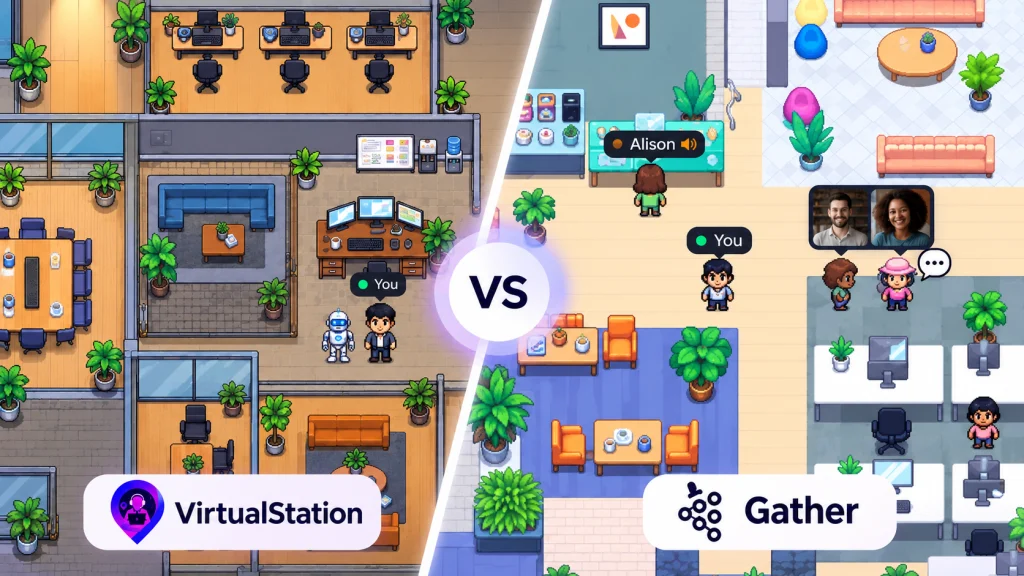
VirtualStation starts from a similar idea to Gather: remote teammates should feel like they are somewhere together, not just appear as names in a sidebar.
Everyone has an avatar in a shared workspace. People can move around, see who is available and start conversations naturally through spatial audio and video.
The difference is what happens around those conversations. VirtualStation also brings projects, tasks, chat, meetings, attendance and manual time tracking into the same workspace, and its AI works from that context. Ask for a project’s status, a team’s numbers or a summary of what happened, and it answers from your own work instead of sending you to find out. That assistant is included on Pro and above. Application and URL activity is recorded only while someone has started tracking their time.
The question is not only: “Can our remote team feel together?” It is also: “Can we run more of the work from the same place?”
VirtualStation is worth considering if your team likes spatial presence but wants fewer gaps between meetings, tasks, standups and day-to-day coordination.
It may not be the best fit if all you want is a playful space for culture and spontaneous conversations. In that case, Gather or SoWork may be simpler.
2. Roam: for teams trying to consolidate the productivity stack
Roam takes a more structured, room-based approach. You can see where people are, knock, join a conversation and return to your room when you are done.
Around that workspace, Roam bundles drop-in meetings, larger events, scheduling, chat, AI meeting summaries, screen recording and an office-aware AI assistant. Its current public pricing is $19.50 per active member per month, with monthly billing.
Roam is worth considering if your priority is productivity, AI and reducing the number of separate work tools. If the playful act of walking around a virtual world is the part your team loves most about Gather, Roam is solving a related but different problem.
3. SoWork: for teams that want something close to the Gather idea
SoWork keeps the shared visual-office model: people have presence, move around, meet naturally and customize the environment.
Its current free plan supports up to 10 members. Paid plans add unlimited calls, richer chat, recordings, analytics and, on Premium, AI summaries, transcripts and action items.
SoWork makes sense if your team basically likes the Gather model and wants another spatial implementation, especially if price is important for a smaller team.
4. Kumospace: for teams that want a polished spatial office
Kumospace uses customizable rooms and floors with a cleaner illustrated-office aesthetic. It includes desktop and mobile apps, chat, recordings on the Business plan, multiple floors and privacy controls.
Its current free plan supports up to five registered members. Business is listed at $16 per user billed yearly, or $20 monthly, with a 5-member minimum.
Kumospace is a strong option when the shared-office metaphor matters, but Gather’s visual style does not fit how you want your company to feel.
5. WorkAdventure: for teams that want control
Some teams are not searching for a better SaaS product. They are searching for something they can own.
WorkAdventure offers a virtual-world approach and, according to its pricing page, supports self-hosting on your own infrastructure or private cloud. That can be attractive to technical teams with stronger privacy, infrastructure or customization requirements.
The trade-off is simple: self-hosting gives you more control, but it also gives you more infrastructure to operate.
Gather alternatives compared
| App | Best for | Beyond the virtual office | Price |
|---|---|---|---|
| Gather | Culture and spontaneous hallway chats | Meetings, chat, AI meeting notes | $15 a user / month$12 billed yearly, 30-day trial |
| VirtualStationOur product | Running the work from the same place you meet | Projects and tasks, AI standups and meeting summaries, attendance, time tracking, AI that answers from your work context (Pro and above) | Free planPro $15 a user / month, $12 billed yearly |
| Roam | Replacing several tools at once | Drop-in meetings, events, chat, AI assistant and summaries | $19.50 an active member / monthBilled monthly |
| SoWork | A Gather-like office on a smaller budget | Chat, recordings, analytics, AI summaries on Premium | Free up to 10 membersPaid plans from $5.40 a member billed yearly, $6 monthly |
| Kumospace | A polished office with its own look | Chat, recordings, multiple floors, analytics | Free up to 5 membersBusiness $16 a user billed yearly, $20 monthly |
| WorkAdventure | Self-hosting and full control | Depends on how you set it up | Free up to 10 users at onceSelf-hosting available |
Prices from each vendor’s public pricing page, checked in September 2026. Plans change, so check before you buy.
Don’t choose a virtual office from the feature table
Every product on this page can look impressive in a demo. That is not the test.
Will your team still open it on a completely ordinary Wednesday three months later?
Before moving the whole company, run your preferred option with five or ten people for a couple of weeks. Do not only ask whether they liked the demo.
- Did people open it without being reminded?
- Did quick questions become quick conversations instead of scheduled meetings?
- Did another tool actually become unnecessary?
- Could managers understand what was moving without chasing everyone?
- Did people eventually fall back to the old workflow?
The first week measures novelty. The third month measures whether you actually changed how the team works.
Which Gather alternative should you choose?
- Culture and playful spatial presence: Gather may still be the right answer.
- Spatial presence plus projects, productivity visibility and AI coordination: look at VirtualStation.
- Maximum tool consolidation with a structured interface: look at Roam.
- A Gather-like experience with a lower-cost entry point: look at SoWork.
- A customizable visual office with a different aesthetic: try Kumospace.
- Self-hosting and infrastructure control: look at WorkAdventure.
The important thing is not choosing the product with the most checkmarks. It is understanding what you are actually trying to fix.
Frequently asked questions
What is the best alternative to Gather Town?
There is no single replacement for every team. VirtualStation is aimed at teams that want spatial presence plus broader team operations and AI coordination; Roam focuses on consolidation; SoWork and Kumospace stay closer to the spatial-office experience; WorkAdventure stands out for self-hosting.
Is there a free Gather alternative?
Yes. SoWork currently offers a free plan for up to 10 members, Kumospace offers a free plan for up to five registered members, and WorkAdventure has a free tier. Gather currently offers a 30-day trial rather than a permanent free tier.
Is Gather still worth using in 2026?
Yes, especially if your team genuinely uses its spatial office and values culture and spontaneous interaction. Switching makes sense when your needs have changed, not simply because another product has more features.
Which Gather alternative is best for productivity?
Roam and VirtualStation approach this from different directions. Roam emphasizes an integrated productivity and AI suite. VirtualStation combines spatial presence with projects, tasks, meetings, attendance, time tracking and AI-assisted coordination.
Can a virtual office replace Slack and Zoom?
For some teams, it can replace part of the stack. The practical test is to run the new workspace with a real team and see which old tools naturally stop being used before cancelling anything.
The alternative you still want to open three months later
A virtual office can look incredible on day one. The real test happens after the avatars stop feeling new.
Gather optimizes strongly for connection and culture. Roam leans toward productivity and consolidation. SoWork keeps much of the playful spatial-office idea. Kumospace offers another visual take. WorkAdventure gives technical teams more infrastructure control.
VirtualStation is our answer for teams that do not want to choose between feeling together and actually running the work.
If that is the problem your team is trying to solve, start with a few teammates. Use it for real work for a couple of weeks, then judge it by the question that matters:
Did working remotely become easier, or did we just add another tool?
Sources
From the VirtualStation team
See who's around, what's moving and what's stuck
VirtualStation puts your team's presence, meetings, chat, tasks and AI standups in one workspace, so the answer to "how's it going?" is already on screen.
No credit card required