Saurabh Rai
Your Team Has AI Agents Now. Who Is Managing Them?
Your agents got delegated work. Nobody got the job of managing them. A practical playbook for owners, permissions, handoffs and review.
On this page
- Somebody Is Already Managing Your Agents. They Just Were Not Told.
- The Person Who Launched the Agent Is Not Automatically Its Owner
- More Automation, More to Review
- A Manager’s Playbook for AI Teammates
- 1. One named owner per agent
- 2. Permissions written as “may, ask, never”
- 3. Handoffs that land somewhere people already look
- 4. Review time on the calendar, not in the gaps
- 5. A short agent review every week
- Count the Management Work as Real Work
- Where This Work Should Live
- What to Do Tomorrow Morning
- Sources
Picture this invented example. It is Wednesday morning and a customer asks why the onboarding emails stopped going out. Nobody knows. The agent that sends them was set up in March by an engineer who has since moved to another project. It still runs. It just started skipping anyone with a company domain it did not recognize, and for three weeks nobody looked.
Nothing about this is dramatic. No one did anything wrong. The agent had a creator, but it never had a manager.
That is the quiet problem with AI agents on small teams: the work got delegated, but the management did not.
Somebody Is Already Managing Your Agents. They Just Were Not Told.
In a September 2026 Business Insider article on workers who have become managers of AI, the people interviewed describe the job in very managerial terms. A freelance technical writer and developer estimates she spends 20% to 30% of her working time managing agents. A product marketing consultant puts her own share at about 30%. These are personal estimates, not survey data, but they are hard to ignore. An engineer at Electrolux calls the oversight “like a loop”: check the results, watch the progress, decide whether to rerun the job or call it finished.
The survey data behind the article comes from the consulting firm BCG. In its 2026 AI at Work survey of 11,749 workers across 14 markets, published in June 2026, 47% said they spend more time managing and directing AI than doing the work itself. In the same survey, half of respondents said their company lacks clear governance for managing teams made up of people and AI.
Read those two numbers together. Half your people may be spending a real chunk of their week supervising software, and half of companies have not decided who is supposed to be doing it. So it falls to whoever happened to press “run” first.
The Person Who Launched the Agent Is Not Automatically Its Owner
Here is a mistake that is easy to make without noticing. We treat an agent like a tool: whoever uses it is responsible for it. That works for a spreadsheet. It breaks for something that keeps working after you close the tab.
A tool waits for you. An agent acts on its own schedule, makes small decisions, and hands work to other people. That is closer to a junior hire than to a spreadsheet, and nobody would let a junior hire report to “whoever talked to them last.”
Microsoft, which sells AI agents and assistants for work, raises the same issue in its 2026 Work Trend Index, published in May 2026. It argues that organizations using agents will have to settle three things: who reviews an agent’s performance, who is allowed to change the workflows it runs, and how a good result on one team gets picked up by others. On a small team, the honest answer to all three may well be “it depends who you ask.”
More Automation, More to Review

The promise was less work. The risk is a different kind of work, in a different place.
When agents draft, summarize, triage and follow up, the bottleneck shifts from doing to checking. I think of this as review debt. Every agent adds output faster than anyone adds time to read it, and unlike technical debt, review debt does not show up anywhere. It shows up as the onboarding emails nobody noticed, or the meeting summary that assigned a task to someone who was not in the meeting.
Most people do take review seriously. In the same Work Trend Index, a survey of 20,000 knowledge workers in 10 countries, 86% of the AI users said they treat AI output as “a starting point, not a final answer.” The trouble is that treating output as a starting point takes time, and unless someone plans for it, it gets squeezed into the gaps.
A Manager’s Playbook for AI Teammates
You do not need a governance committee. You need the same five things you would sort out for a new person on the team.
1. One named owner per agent
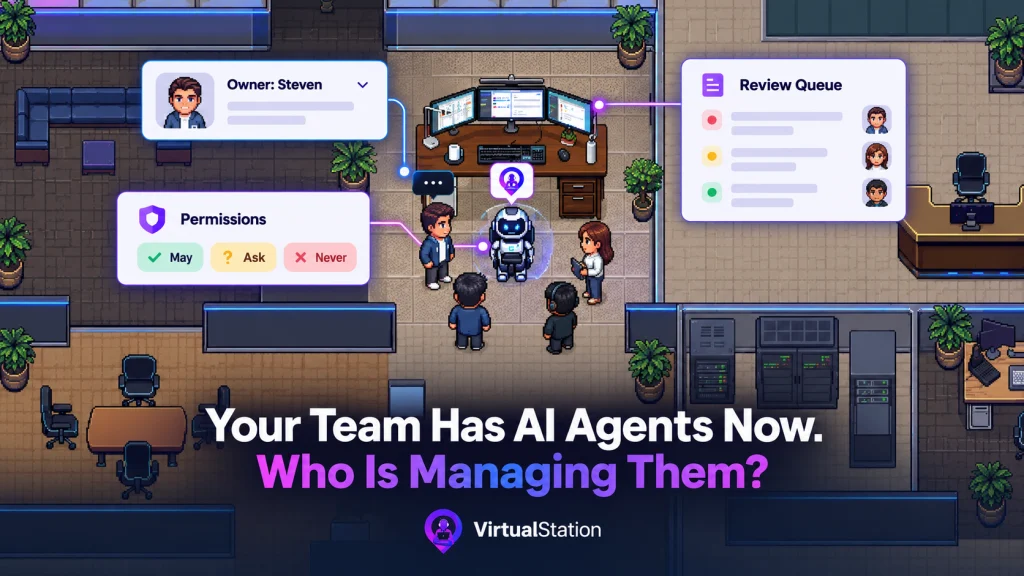
Not the creator, not “engineering.” One person who answers when it misbehaves, who decides when it gets changed, and who can switch it off. If that person goes on leave or changes teams, ownership moves with a handoff, like any other responsibility.
2. Permissions written as “may, ask, never”
In an April 2026 essay, Rethinking operating models for humans with agents, Deloitte suggests that leaders settle decision rights before an agent starts work: what it can decide alone, what needs a human to sign off, and what should be escalated. For a small team, that fits in three short lines. The support agent may tag and route tickets. It must ask before issuing a refund. It will never email a customer about pricing.
3. Handoffs that land somewhere people already look
Every agent produces something: a draft, a summary, a list of action items. Decide where that output goes and who picks it up. If the answer is “a dashboard nobody opens,” the handoff is broken before it starts.
4. Review time on the calendar, not in the gaps
If someone owns three agents, budget the time to check them. Put it in their week the same way you would put in one-on-ones. If you cannot find the time, that is useful information: you may have more agents than your team can supervise.
5. A short agent review every week
Ten minutes in your team meeting. For each agent: what did it do, what went wrong, should we keep it, fix it or retire it? Retiring agents is underrated. An agent nobody reviews is a liability with a friendly name.
Count the Management Work as Real Work
There is a fairness question here too. The Business Insider article cites early data from an upcoming survey by Visier, a workforce analytics company: 54% of full-time US employees surveyed said their roles or careers had changed significantly because of AI in the past two years, and of those, only 17% had been promoted. The CEO of Syndio, a compensation software company, makes the point sharply. If you assign work to five agents, judge their output, correct them and answer for the result, she asks, “what exactly makes me an individual contributor anymore?”
You probably cannot hand out new titles this quarter. You can make the work visible. When someone owns agents that the team depends on, say so in their goals and talk about it in their review. People notice when invisible work stays invisible.
Where This Work Should Live
The practical problem with all of the above is that agent work tends to happen in private: in one person’s chat window, in a tool’s own dashboard, in a transcript nobody reopens. You cannot review what you cannot see.
This is one reason we are building VirtualStation around a different assumption: that AI work should show up in the same place as everyone else’s work. AI standups collect updates and surface blockers in the same workspace as the tasks. Meeting summaries suggest action items, owners and due dates. Overdue tasks are visible per person, so a manager can see where work is piling up instead of reconstructing it from chat. It does not answer the ownership question for you. It does make the answer hard to ignore.
What to Do Tomorrow Morning
Open a shared doc and list every agent, bot and automation your team runs. For each one, write three things: who owns it, what it may do without asking, and where its output goes. If you find an agent nobody claims, start there.
Someone on your team is already managing your agents. The only real question is whether you chose them.
If this is the kind of team problem you are trying to solve, VirtualStation is being built around exactly this idea. You can try it free.
Sources
- Business Insider, AI is turning workers into managers without promotions or raises, September 2026
- BCG, AI Is Reshaping Jobs Faster Than Companies Are Reshaping Work, June 2026
- BCG, AI at Work: Why Strategy Matters More Than Tools, June 2026
- Microsoft, 2026 Work Trend Index, May 2026
- Deloitte Insights, Rethinking operating models for humans with agents, April 2026
From the VirtualStation team
See who's around, what's moving and what's stuck
VirtualStation puts your team's presence, meetings, chat, tasks and AI standups in one workspace, so the answer to "how's it going?" is already on screen.
No credit card required