Saurabh Rai
The 10-Person Company of 2027 May Have 30 AI Coworkers
Draw your org chart, then add a box for every AI agent. The second drawing may be bigger. What that means for ownership and management.
On this page
Draw your company’s org chart. If you run a small team, it probably fits on a napkin: a founder, a few engineers, someone in sales, someone holding operations together.
Now add a box for every AI agent that does recurring work for you. The one that triages support tickets. The one that writes meeting notes. The one that drafts outreach, the one that reviews pull requests, the one that reconciles invoices on Fridays.
For some teams, the second drawing may already be bigger than the first. And it is easy never to draw it.
Thirty Is a Thought Experiment. It May Also Be Conservative.
Let us be clear up front: “30 AI coworkers for 10 people” is not a statistic. Nobody has measured it. It is a way of asking what happens to a small company when agents outnumber humans three to one.
But the direction is not speculative. In a September 2026 Business Insider article, the CEO of Daytona, a 30-person AI startup, said each of its 16 engineers manages an average of five AI agents. That is one CEO’s description of his own company, not a survey, but it works out to roughly 80 agents among 16 engineers, well past three to one.
The broader numbers point the same way. In the consulting firm BCG’s 2026 AI at Work survey of 11,749 workers across 14 markets, 30% of respondents said agents were already part of their workflows, up from 13% in the previous year’s survey. Microsoft, which sells AI agents and assistants for work, surveyed 20,000 knowledge workers in 10 countries for its 2026 Work Trend Index. It describes a group it calls Frontier Professionals, who use agents for multi-step workflows and build systems of several agents working together. They made up 16% of the AI users in that survey: a minority, but not a fringe.
So the question for 2027 is less “will small companies have this many agents?” and more “will anyone know what they are all doing?”
The Org Chart Was Built to Answer One Question
An org chart looks like a picture of who reports to whom. What it really answers is: when something goes wrong, whose name comes up?
Deloitte makes a similar point in an April 2026 essay, Rethinking operating models for humans with agents. For decades, it notes, org charts assumed a human sat at every point where a real decision gets made. Agents break that assumption. They make choices, small ones, all day, and none of them can be held accountable. Deloitte warns that ownership “can become muddled,” from who holds decision rights to who answers for quality.
In a 10-person company, muddled ownership is not an abstract risk. It is the refund that went out without approval, or the prospect who got the same email three times.
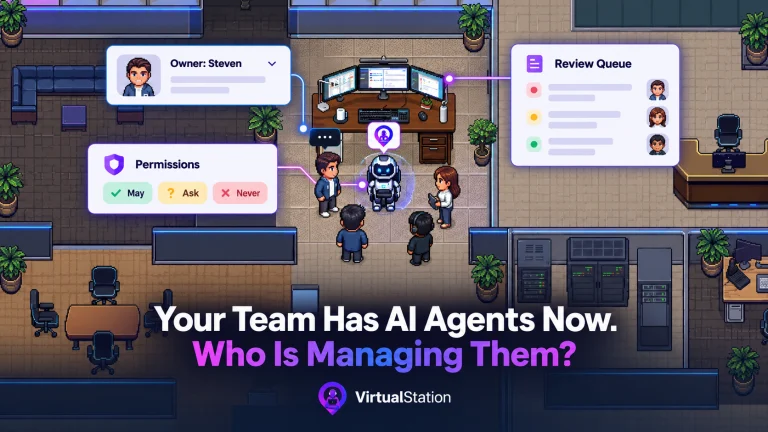
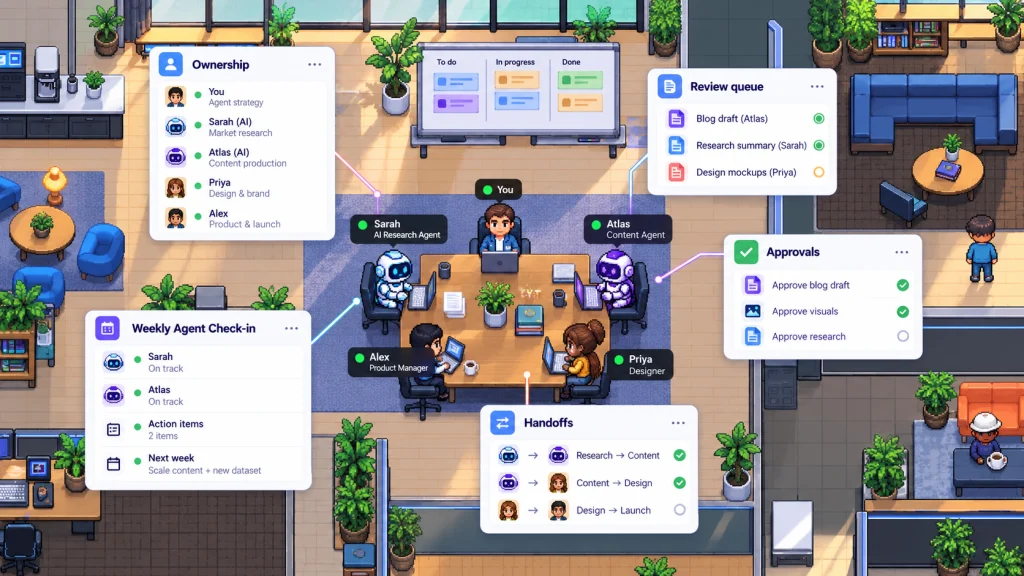
Here is the change I think small companies will have to make: the org chart becomes a responsibility map. Every agent box hangs off a human box. No floating agents, no “the team owns it.” If you cannot draw the line from an agent to a person, that agent should not be running.
In its Tech Trends 2026 chapter, The agentic reality check: Preparing for a silicon-based workforce, Deloitte goes further. It suggests agents may come to be treated as a “silicon-based workforce,” and that companies will need a record of what each agent did, why, and “under whose authority they acted.” That last phrase is the one to hold on to. Under whose authority. For a small company, the answer should always be a name.
Permissions Become the New Job Description
When you hire a person, the job description tells them what they are responsible for. When you add an agent, the equivalent is what it is allowed to do.
Deloitte’s operating-model essay suggests settling decision rights before an agent starts work: what it can decide alone, what needs a human to sign off, and what should be escalated. In a company with 30 agents, that list is the job description. It is also easy to skip, because the agent was set up in an afternoon and seemed to work.
A simple test: for each agent, could a new hire read one paragraph and know what it may do, what it must ask about, and what it will never touch? If not, the agent’s permissions live in one person’s head. That works right up until that person is on vacation.
Management Stops Being a Title
Microsoft has been describing this shift since its 2025 Work Trend Index, which predicted that every employee would become an “agent boss,” someone who builds agents, delegates to them and manages them. In that survey of 31,000 knowledge workers in 31 markets, 41% of leaders said they expect their teams to be training agents within five years, and 36% expect them to be managing agents.
In a small company, this has a consequence people rarely talk about. Your constraint stops being headcount and becomes supervision capacity. Agents are cheap to add. The attention needed to check their work is not. Deloitte asks the question directly: “How many digital agents can a human manage and be accountable for?”
Nobody has a good answer yet, and the answer will differ by person. But it suggests a better hiring question for 2027. Not only “do we need another person?” but “does anyone on the team have room to supervise another agent, or will adding one quietly overload someone who is already stretched?”
It also suggests the load will be lumpy. Thirty agents across ten people is three each on paper. In practice the operations lead might own twelve and the designer none. That imbalance is where things will slip.
A Speculative Week at the 10-Person Company
To make this concrete, here is one imagined version. It is a sketch, not a forecast.
Monday, the founder reviews what the sales agents sent last week and kills a sequence that sounds off-brand. The operations lead spends Tuesday morning fixing an invoicing agent that misread a new vendor’s format. Two engineers each supervise several coding agents and spend more time reviewing pull requests than writing code. On Thursday, the team meeting includes a short agent review: two get tuned, one gets retired because nobody could say what it was still for.
Nothing in that week is futuristic. Most of it is ordinary management, pointed at a different kind of worker. The companies that do well will not be the ones with the most agents. They will be the ones that noticed management moved and planned for it.
What to Do While You Are Still at Ten
- Draw the second org chart. List every agent and automation. Put a person’s name next to each one.
- Write one paragraph per agent: what it may do, what it must ask about, what it will never do.
- Look at the lumps. If one person owns most of the agents, that is your single point of failure.
- Make agent work visible. If you only find out what an agent did when a customer complains, it is working somewhere nobody looks.
That last one is the reason we are building VirtualStation the way we are. We started from the assumption that people and AI should work in one place, so a manager can see the team, the meetings, the tasks and what the AI contributed without piecing it together from five tools. AI standups surface blockers, meeting summaries suggest action items, owners and due dates, and overdue tasks are visible per person. It will not decide who owns your agents. It will make gaps in ownership easier to spot.
The Real Measure
The 10-person company of 2027 might run 30 agents, or 80, or five. The number will not matter much. What will matter is whether, when something goes wrong at 4pm on a Friday, anyone knows whose name belongs next to it.
If that is the kind of team you are trying to build, VirtualStation is being built around exactly this idea. You can try it free.
Sources
- Business Insider, AI is turning workers into managers without promotions or raises, September 2026
- BCG, AI Is Reshaping Jobs Faster Than Companies Are Reshaping Work, June 2026
- Microsoft, 2026 Work Trend Index, May 2026
- Microsoft, 2025 Work Trend Index, April 2025
- Deloitte Insights, Rethinking operating models for humans with agents, April 2026
- Deloitte Insights, The agentic reality check: Preparing for a silicon-based workforce, December 2025
From the VirtualStation team
See who's around, what's moving and what's stuck
VirtualStation puts your team's presence, meetings, chat, tasks and AI standups in one workspace, so the answer to "how's it going?" is already on screen.
No credit card required