Saurabh Rai
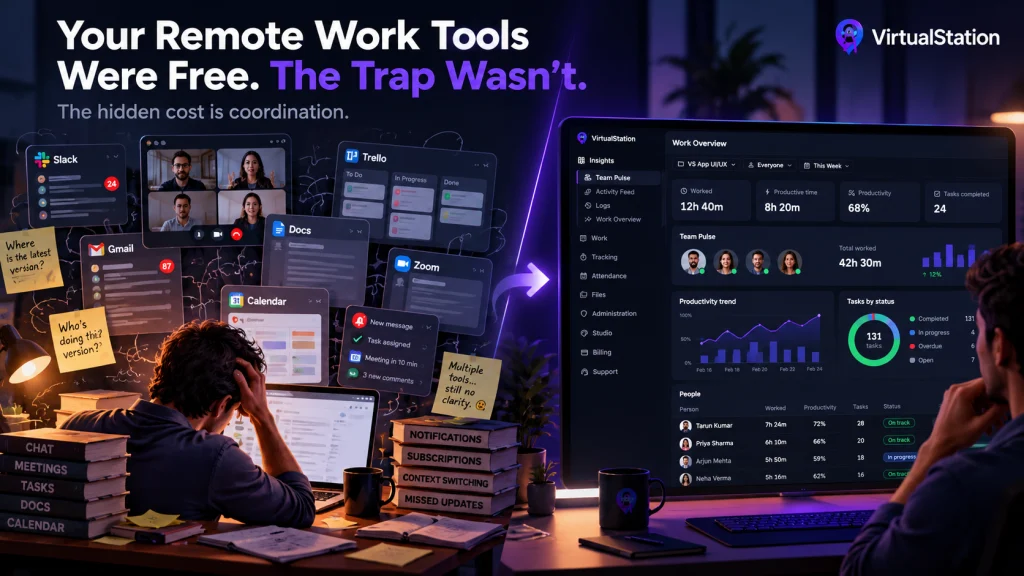
Your Remote Work Tools Were Free. The Trap Wasn’t.
The biggest expense of remote work isn't always salaries or office space. Sometimes it's the software stack you built to save money.
On this page
- It starts with a free plan. It rarely ends there.
- The real cost isn’t the subscription. It’s everything around it.
- The migration problem nobody warns small companies about
- Founders don’t need another dashboard. They need to stop chasing updates.
- So what should efficient remote work tools actually do?
- 1. Conversations should happen naturally, not become calendar events
- 2. Project visibility shouldn’t require constant reporting
- 3. Work and communication should share context
- 4. Software should reduce expenses, not multiply subscriptions
- 5. AI should remove coordination work, not create another tool to manage
- The question founders should ask before buying another tool
- Remote work doesn’t need more tools. It needs a better way to work.
- Sources
The biggest expense of remote work isn’t always salaries, subscriptions, or office space.
Sometimes, it’s the stack of remote work tools you built to save money in the first place.
Have you ever wondered why almost every remote work app promises better collaboration, yet companies keep adding more tools just to get work done?
One app for communication. Another for meetings. One for project management. Another for documentation. A separate tool for time tracking. And eventually, a dashboard to understand what’s happening across all of them.
Every tool promises to solve a problem.
But here’s the question nobody asks early enough:
If all these tools are making remote work easier, why is managing a remote team becoming more complicated?
The answer usually begins long before a company realizes it has a problem.
It starts with a free plan. It rarely ends there.
Picture a startup with five employees.
The founder is careful with expenses. Every dollar matters. So the team starts with free tools.
A messaging app for communication. A project management tool for tasks. A video meeting platform for discussions. Shared documents for everything else.
Perfect. No significant software expenses. Everyone is happy.
Six months later, the team grows to 15 people.
Suddenly, the free plans aren’t enough. Message history becomes limited. Storage fills up. Features that seemed unnecessary at five people are essential at fifteen.
So the founder upgrades a few subscriptions.
No big deal. Business is growing, after all.
Another six months pass.
Now there are 30 employees, several projects, and different departments. Some teams prefer one tool, while others have already built their workflows somewhere else.
Information begins spreading across platforms.
A decision happens in a chat. The task gets updated elsewhere. The relevant document lives in another application. And the founder learns about a missed deadline during a scheduled status meeting.
The company has more software than ever, but less clarity about what’s happening.
Nobody deliberately designed this complexity. It simply accumulated, one reasonable decision at a time.
And that is what makes the trap so effective.
The real cost isn’t the subscription. It’s everything around it.
When founders compare software, they naturally compare subscription prices.
$5 per user. $10 per user. $20 per user.
But subscription pricing captures only a fraction of the actual cost.
Think about what happens throughout an ordinary workday.
An employee receives a message asking about a project. They open the project management tool, check the latest task update, find a related document, return to the messaging app, and explain the progress.
Another employee needs a quick clarification. Instead of walking over to a teammate, they check their availability, send a message, and eventually schedule a call.
Meanwhile, the founder wants to understand whether a release is on track.
That requires checking the dashboard, messaging the lead, reviewing updates, and possibly organizing another meeting.
Everyone is working.
But an uncomfortable amount of time is being spent simply figuring out what everyone else is doing.
This isn’t just a hypothetical concern.
Asana, which sells work management software, surveyed 9,615 knowledge workers in six countries for its 2023 Anatomy of Work Global Index. Respondents said “work about work” took up 58% of their day: coordinating, communicating, and organizing work rather than doing the skilled work itself.
And Microsoft, which sells AI tools for work, surveyed 31,000 workers in 31 markets for its 2025 Work Trend Index. 48% of employees and 52% of leaders said their work feels chaotic and fragmented.
These findings don’t mean software is the sole cause. But they expose a serious problem with how modern work is organized.
We have become exceptionally good at creating ways to communicate about work.
We haven’t been nearly as successful at reducing the need to.
The migration problem nobody warns small companies about
Here’s where the situation becomes even more interesting.
Imagine the founder finally recognizes the problem.
There are too many subscriptions. Too much duplication. Too many disconnected workflows.
The obvious solution seems simple.
Let’s consolidate everything.
But moving from one tool to another isn’t as easy as switching subscriptions.
There are years of conversations, project histories, files, permissions, integrations, internal links, and established workflows.
Employees already know how the current systems operate. New employees have been trained around them. Important decisions are buried inside them.
Moving means figuring out what can be exported, what must be rebuilt, what cannot be transferred cleanly, and how to keep the business running during the transition.
And startups don’t have unlimited engineering capacity or operational resources to dedicate to migrations.
So what happens?
They postpone it.
Instead of replacing the old platform, they subscribe to a new one and keep the previous tool for historical access or an existing workflow.
The software that was supposed to reduce complexity becomes another layer of it.
This is how companies end up paying for yesterday’s decisions while financing tomorrow’s tools.
The problem has a name: SaaS sprawl.
Zylo, which sells SaaS management software, reported in its 2026 SaaS Management Index that organizations in its dataset managed an average of 305 SaaS applications, while average SaaS spending increased 8% year over year.
A five-person startup obviously doesn’t have the same technology footprint as an enterprise. But the underlying pattern can begin at any size.
Every new application introduces a potential dependency.
And dependencies are easy to add, but often expensive to remove. The same pattern is now repeating with AI, which we wrote about in AI agent sprawl is the new SaaS sprawl.
Founders don’t need another dashboard. They need to stop chasing updates.
For many founders, the original reason to build a company was to create something valuable.
A product. A service. A solution to a real problem.
Yet as the team grows, their calendars gradually fill with activities that look like management but often amount to collecting information.
- Monday: project status meeting.
- Tuesday: follow-up with the development team.
- Wednesday: review blockers.
- Thursday: another progress discussion.
- Friday: weekly summary.
Some of these conversations are genuinely important. Decisions need to be made, people need support, and complex problems benefit from discussion.
But how many meetings exist simply because the founder cannot see what’s happening without asking?
And how many employees must interrupt their work to prepare updates about the work they were already doing?
Eventually, founders respond by hiring project managers, introducing more reporting processes, or purchasing another tool promising improved visibility.
Sometimes those investments are justified. Good managers provide leadership, coaching, and judgment that no dashboard can replace.
But hiring someone primarily to chase status updates is a different story.
If every new employee creates more work just to understand the existing work, the problem isn’t necessarily headcount. It’s the operating system of the company.
Growth should increase what a team can accomplish, not proportionally increase the effort required to coordinate it.
So what should efficient remote work tools actually do?
Let’s forget feature comparisons for a moment.
Forget how many integrations a platform offers, how impressive its AI assistant sounds, or how many different dashboards it can generate.
Imagine walking into a well-run physical office.
You can see who’s around. You know which team is working together. If you need a quick answer, you walk over and ask. You can discuss something for two minutes and return to work without turning every interaction into a calendar event.
You don’t need to schedule a meeting to find out whether someone is available.
You don’t need five applications to understand the progress of one project.
And your manager doesn’t need to interrupt you every hour just to confirm that work is happening.
Remote software should preserve the useful parts of that experience without bringing back the cost and constraints of a physical office.
1. Conversations should happen naturally, not become calendar events
Not every question needs a meeting link.
Sometimes an engineer needs two minutes with a designer. Sometimes a founder wants to discuss an idea with a teammate.
The technology should make those interactions easy, just as a physical office does.
Scheduled meetings should be reserved for conversations that genuinely benefit from planning, preparation, and participation.
2. Project visibility shouldn’t require constant reporting
A founder should be able to understand which projects are progressing, who owns the next step, what has been completed, and where support is needed.
Not by checking whether an employee’s status indicator is green.
Not by watching their screen.
But through clear ownership, meaningful progress, visible blockers, and reliable project information.
Visibility should create trust, not surveillance.
If this is the part you struggle with most, we went deeper in how to know what your remote team is doing without micromanaging them.
3. Work and communication should share context
A discussion about a task shouldn’t disappear into an unrelated chat history.
When conversations, ownership, decisions, and project updates remain connected, teams spend less time reconstructing context.
The value isn’t simply having chat and tasks inside the same application.
It’s reducing the effort required to move from a conversation to a decision, and from a decision to action.
4. Software should reduce expenses, not multiply subscriptions
The goal is not necessarily to eliminate every specialized tool. A development team may still need its code repository, and a design team may still need professional design software.
But common everyday activities shouldn’t automatically require a collection of overlapping subscriptions.
Communication, quick discussions, project coordination, and team visibility should work together wherever that genuinely saves time and money.
The best software investment isn’t always the one with the lowest per-user price.
It’s the one that delivers the most useful work with the least operational overhead.
5. AI should remove coordination work, not create another tool to manage
AI can help summarize discussions, identify blockers, surface relevant information, and reduce repetitive administrative tasks.
But adding an AI subscription to an already fragmented workflow doesn’t automatically make that workflow efficient.
The real opportunity is using AI to reduce the manual coordination people no longer need to perform.
A founder should spend less time searching for answers. A team should spend less time preparing updates.
That’s a meaningful productivity improvement.
The question founders should ask before buying another tool
Before adding another subscription, ask yourself something more useful than “Does this software have the features we need?”
Ask:
“What work will my team no longer have to do after adopting this software?”
- Will it eliminate unnecessary meetings?
- Will it reduce the time spent requesting status updates?
- Will it replace an overlapping subscription?
- Will it make important information easier to find?
- Will it improve how new team members understand existing projects?
And when the company doubles in size, will this tool continue simplifying operations, or will it require another layer of software to manage it?
These questions change the way we evaluate remote work technology.
A tool that costs $10 per employee but saves several hours of unnecessary coordination may be a better investment than a free tool that creates more work elsewhere.
And an expensive platform that merely duplicates existing capabilities may deliver little value regardless of how impressive its feature list looks.
Remote work doesn’t need more tools. It needs a better way to work.
Remote work has already given businesses an extraordinary advantage.
Companies can hire beyond geographic boundaries, avoid significant office expenses, and build teams around talent instead of location.
But some of those savings disappear when companies replace the physical office with a growing collection of disconnected digital tools.
At VirtualStation, this is the problem we’re working to solve.
Our goal isn’t to make remote work feel more digital.
It’s to make running a remote company more efficient.
To help founders escape the endless cycle of chasing status updates.
To help employees avoid meetings that could have been two-minute conversations.
To bring office-like accessibility, communication, and project visibility closer together in one virtual office, so teams can spend more time working and less time coordinating work.
And to reduce the need to pay for multiple overlapping applications when one connected workspace can handle the job.
Because the real promise of remote work was never simply working from anywhere.
It was the freedom to build and grow businesses with fewer unnecessary costs and constraints.
We eliminated the expense of the physical office.
Now it’s time to eliminate the unnecessary expense of managing the digital one.
And perhaps the next time a software company promises to improve remote collaboration, founders should ask one simple question:
“Will this help us do more work, or will it just give us another place to talk about it?”
If you’d like to see how VirtualStation handles it, the Starter plan is free, or you can start a free trial.
Sources
- Asana, Anatomy of Work Global Index 2023, 2023
- Microsoft, 2025 Work Trend Index: Breaking down the infinite workday, June 2025
- Zylo, 2026 SaaS Management Index, 2026
From the VirtualStation team
See who's around, what's moving and what's stuck
VirtualStation puts your team's presence, meetings, chat, tasks and AI standups in one workspace, so the answer to "how's it going?" is already on screen.
No credit card required