Saurabh Rai
Remote Team Culture: How to Build It Without Forced Fun
Remote team culture is built in how ordinary work happens, not in mandatory trivia nights. Ten practical habits, the latest Gallup data and ways to measure it.
On this page
- What is remote team culture?
- Why forced fun backfires
- The problem forced fun is trying to solve is real
- What remote team culture is actually made of
- Warning signs your remote culture is drifting
- How to build remote team culture without forcing it
- 1. Write your values as behaviors
- 2. Write down how you work together
- 3. Onboard people into the culture, not just the tools
- 4. Make small contact easy and optional
- 5. Put the rituals inside working hours
- 6. Build bridges between teams on purpose
- 7. Recognize work in public, specifically
- 8. Make managers the carriers of culture
- 9. Meet in person with a purpose, if you can
- 10. Respect the opt-out
- How to tell if your remote team culture is working
- Where VirtualStation fits
- Frequently asked questions
- What is remote team culture?
- How do you build culture in a remote team?
- How do you make remote employees feel connected?
- Are virtual team building activities worth it?
- How is remote culture different from office culture?
- Culture is the workday, not the party
- Sources
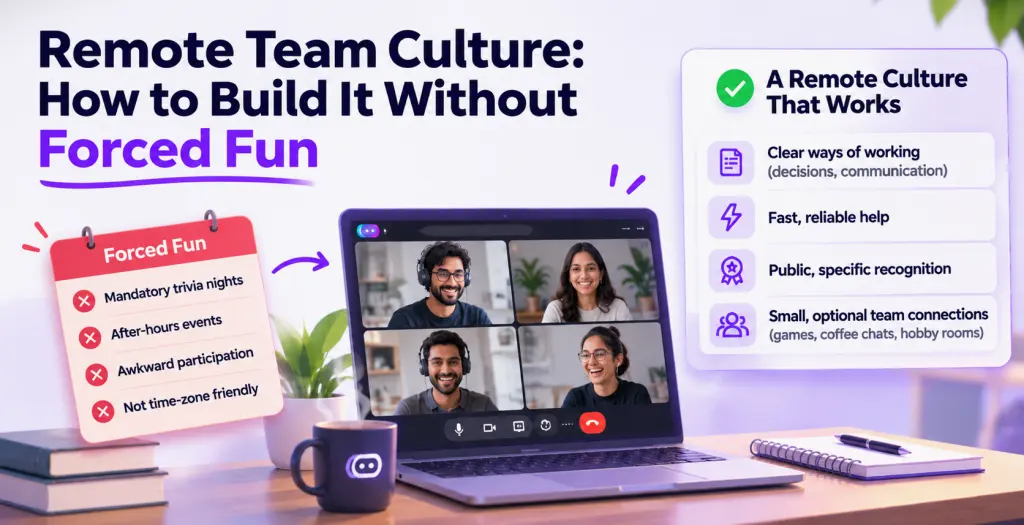
Take an invented example. A 30-person remote company decides its culture needs work, so it books a mandatory virtual trivia night every second Thursday at 5 p.m. London time. For the developer in Manila it starts at midnight. For the designer with two small children it lands on bath time. Three months later, attendance is down to the founders and the two people who sit closest to them on the org chart, and someone suggests a virtual escape room.
The short answer: remote team culture is the shared habits, values and expectations that shape how a distributed team works together. You build it mostly inside the workday: write down how decisions and communication work, answer questions fast, recognize specific work in public, and offer small, optional ways to connect. Mandatory after-hours events rarely help.
Most remote team culture advice is some version of that trivia night. This article argues for something different. Culture in a remote team is mostly built in how decisions get made, how help arrives and what gets noticed. Social connection matters a lot, but it works best when it is small, optional and designed for remote life, rather than an office party moved onto video.
What is remote team culture?
Every company has a culture, whether anyone designed it or not. In an office, much of it is absorbed by watching: who stays late, how the manager reacts to bad news, which jokes land in the kitchen. Remote teams lose most of that ambient learning. A new hire can’t overhear how things are done, so the culture they experience is whatever shows up in their messages, meetings and documents.
GitLab’s guide to building a remote work culture puts the difference well: “In a colocated setting, culture is typically formed through tacit or implicit knowledge. In a healthy remote work environment, the building blocks of culture are documented transparently, making them accessible to everyone.” The same page says “there should be no unwritten rules in remote culture.”
Office culture can survive being vague, because people fill the gaps by watching each other. Remote work culture can’t. If it isn’t written down or visible in the work itself, most of the team never sees it.
Why forced fun backfires
Forced fun fails for practical reasons before it fails for emotional ones. It lands at a bad time for someone in every distributed team. It is extra screen time on top of a full day of screens. And it measures commitment by attendance, which quietly punishes caregivers, introverts and anyone in the “wrong” time zone.
GitLab’s handbook page on informal communication names the tension plainly: “While some people thrive on spending time to get to know others, others are annoyed by non-work-related texts and messages.” The same page suggests “community impact outings” as an alternative to video happy hours, where each person spends an hour volunteering locally at a time that suits them and shares what they did afterwards.
There is also a data point that should make anyone planning another quiz night pause. In a U.S. study Gallup cites in its analysis of workplace loneliness, engaged employees were 64% less likely to be lonely than those who were not engaged. Employees who felt their opinions counted were 39% less likely to be lonely, and those who got to do what they do best every day were 37% less likely. Having a best friend at work was among the weakest of the 12 engagement items, at 21% (Gallup, June 2024). Friendship matters. Being heard and doing meaningful work mattered more.
The problem forced fun is trying to solve is real
None of this means remote teams should ignore connection. Gallup’s 2026 State of the Global Workplace data, collected during 2025, shows an odd split for exclusively remote workers (Gallup, April 2026):
| Measure (global, 2025 data) | Exclusively remote | Hybrid | On-site, remote-capable |
|---|---|---|---|
| Engaged at work | 30% | 25% | 24% |
| Thriving in overall life | 33% | 45% | 45% |
| Lonely a lot of the previous day | 24% | 24% | 18% |
| Sad a lot of the previous day | 30% | 24% | 20% |
Remote workers are the most engaged group, but they are less likely to be thriving and more likely to report loneliness and sadness than people who can work remotely but go in. Connection to the bigger picture also slips. In U.S. data from 2023, only 28% of exclusively remote employees strongly agreed they felt connected to their organization’s mission or purpose, tying the record low for that group (Gallup, August 2023).
Remote work also changes who you talk to. A Microsoft study of more than 61,000 of its own employees in the first half of 2020 found that company-wide remote work made collaboration more siloed. People spent about 25% less of their time collaborating with colleagues across groups, and shifted toward asynchronous communication (UC Berkeley summary of the study, published in Nature Human Behaviour).
So the goal is right. The method is wrong. Loneliness and silos are not cured by one big mandatory event. They are cured by many small, low-pressure points of contact, and by work that makes people feel useful and heard.
What remote team culture is actually made of
A useful test: culture is what a new hire would describe after three months if you asked “what’s it really like here?” They almost never mention the events. They describe things like:
- How decisions get made. Are they written down where everyone can see them, or settled in calls that half the team missed?
- How fast help arrives. When you are stuck, does someone answer within the hour, or do you wait a day and feel like a nuisance?
- How mistakes are treated. Do people say “I broke this” in the public channel, or hide it?
- What gets noticed. Is it visible effort, like being online late, or real results?
- Whether it’s okay to be offline. Can you take an afternoon for a dentist appointment without writing an apology?
All five are built during the workday, by managers and teammates, mostly in writing. That is good news. It means you can improve remote team culture without adding a single event to anyone’s calendar.
Warning signs your remote culture is drifting
- Important decisions keep surfacing in private DMs or calls, and people find out after the fact.
- New hires ask the same basic questions in month three that they asked in week one.
- The same three people speak in every meeting, and the rest stay on mute.
- People send messages at 11 p.m. to show they are working, and others feel they must reply.
- Praise goes to whoever is most visible rather than whoever did the work.
How to build remote team culture without forcing it
1. Write your values as behaviors
“Transparency” on a careers page tells a new hire nothing. “Decisions that affect more than one team are written up in the project channel within a day” tells them exactly what to do. GitLab’s test is a good one: you should be able to hand your values to someone who doesn’t work at your company and they would understand how to treat you and your colleagues. Its handbook also notes that values need to be “visibly reinforced”, for example by linking promotions to them.
2. Write down how you work together
A one-page team agreement covering response times, core overlap hours, where decisions get recorded and how people signal they are focused or offline does more for culture than most offsites. Gallup found hybrid employees on teams with an agreed plan for working together were 66% more likely to be engaged (Gallup, July 2024). Our post on remote team documentation covers how to keep that kind of page alive.
3. Onboard people into the culture, not just the tools
The first few weeks are when a remote hire learns what is really expected. Give them a named buddy, a short list of people to meet, and real work early. GitLab’s handbook notes that “every person who joins GitLab has to schedule at least 5 coffee chats during their onboarding”, which makes connection a deliberate part of starting rather than a party you are expected to attend forever. Our remote onboarding checklist covers the first 90 days, and for longer-term support, see our guide to building a culture of mentorship in remote teams.
4. Make small contact easy and optional
Random pairings for a 20-minute coffee chat, an open video room people can drop into while they work, a channel for pet photos. The key word is optional.
5. Put the rituals inside working hours
If something matters to your culture, it deserves company time. A fortnightly demo where people show what they shipped, a monthly “what I learned” session, or a short show-and-tell at the start of a team meeting all build connection around the work itself. Rotate the time if you span time zones, and record it for whoever can’t make it.
6. Build bridges between teams on purpose
The Microsoft study shows silos form quickly when work goes remote. Counter that with cross-team pairings, shared demos, and open channels where questions get answered by whoever knows, not only by your own team.
7. Recognize work in public, specifically
“Great job everyone” is wallpaper. “Ana’s fix to the import job saved support about twenty tickets this week, here’s the thread” tells the whole team what you value. It also helps people outside the founder’s circle get noticed. See our piece on proximity bias in hybrid teams for why that matters.
8. Make managers the carriers of culture
In a remote team, the manager is often the only person who sees each individual every week. Gallup’s 2023 report on remote workers drifting from their organizations concludes that managers need to use meaningful interactions to build engagement, and that people need to see how their work connects to the mission. In practice that means one-on-ones about the person, not status, and managers who answer questions quickly. Nothing teaches someone “this is a lonely place” faster than a question that sits unanswered for a day.
9. Meet in person with a purpose, if you can
If your budget allows, an occasional in-person gathering can do a lot. Make it about things that are hard remotely, such as planning, mentoring and simply spending unstructured time together, and don’t pack it with presentations people could have watched at home.
10. Respect the opt-out
The person who skips the social channel and never joins the coffee roulette may be your most engaged employee. Judge commitment by the work and by how people treat each other, never by event attendance.
| Forced fun | Culture that works remotely |
|---|---|
| Mandatory after-hours events | Optional, short, recurring contact during the workday |
| One fixed time for everyone | Rotating times, recordings, async options |
| Attendance as a proxy for commitment | Results and helpfulness as the measure |
| Generic praise | Specific recognition linked to the work |
| Values as slogans | Values written as behaviors and reflected in promotions |
| Culture as an HR program | Culture as daily habits owned by managers and teams |
| Hallway chats that leave remote people out | Decisions and context written down for everyone |
How to tell if your remote team culture is working
Event attendance is a poor measure. Watch signals from the work itself, and ask people directly a couple of times a year.
Signals you can watch:
- How long questions in public channels wait for a first useful answer.
- Whether decisions can be found in writing a week later.
- Who speaks in meetings and who gets credited in recognition posts.
- Whether people actually take their leave and log off at the end of their day.
Questions to ask in a short anonymous pulse survey (our suggestions, rated 1 to 5):
- When I’m stuck, I know who to ask and I get help quickly.
- I understand how my work connects to what the company is trying to do.
- My opinions are heard, even when I can’t make the meeting.
- I can be offline outside my working hours without it counting against me.
- I have at least one colleague I’d feel comfortable asking for help with something non-urgent.
Ask the same questions each time so you can see the trend, and share what you will change. A survey that leads to nothing teaches people their opinions don’t count.
Where VirtualStation fits
We make VirtualStation, so weigh this accordingly. Our view is that a lot of what people miss from offices is not events but ambient contact: seeing that a colleague is free and asking a quick question, or noticing who’s around. VirtualStation is a virtual office with team presence and rooms, so people can see who is available, in a meeting or focused, and walk over to talk without booking a call. Chat, meetings, whiteboards and projects sit in the same workspace, which makes it easier to keep decisions and recognition where everyone can see them.
Who it is not for: if your team is deeply async and prefers not to show live presence at all, a virtual office may feel like more than you want. A good chat tool, a written handbook and a few optional rituals may be all you need. Our post on setting up a virtual office covers how to decide.
Frequently asked questions
What is remote team culture?
Remote team culture is the set of shared habits, values and expectations that shape how a distributed team communicates, makes decisions and treats each other. Because remote employees can’t absorb norms by watching an office, it lives mostly in what is written down, how managers behave and what gets recognized. It exists whether you design it or not, so it pays to be deliberate.
How do you build culture in a remote team?
Start with the work. Write your values as concrete behaviors, agree team norms for response times and where decisions are recorded, and onboard new people with a buddy and introductions. Then recognize specific work in public, keep rituals inside working hours, and add small optional ways to connect, like coffee chats. Review it with a short pulse survey once or twice a year.
How do you make remote employees feel connected?
Make sure they are heard and useful first. Gallup’s loneliness research found that feeling your opinions count and doing what you do best every day were more strongly linked to lower loneliness than having a best friend at work. Answer their questions quickly, include them in decisions in writing, credit their work by name, and offer optional small-group contact rather than large mandatory events.
Are virtual team building activities worth it?
Some are, if they are optional, short, held during working hours and suited to the people involved. Rotating demo sessions, coffee pairings and interest channels tend to work. Mandatory after-hours games often backfire, especially across time zones or for caregivers, because they turn connection into an attendance test. Treat activities as a supplement to good daily habits, not a substitute.
How is remote culture different from office culture?
Office culture is largely implicit: people learn it by watching colleagues and overhearing conversations. Remote culture has to be explicit, because that ambient learning disappears. Norms, values and decisions need to be written down, and connection has to be designed rather than left to chance meetings in the kitchen. Done well, that makes remote culture fairer, since everyone sees the same information.
Culture is the workday, not the party
The companies with the strongest remote team culture are rarely the ones with the most events. They are the ones where questions get answered, decisions are written down, good work is noticed by name and nobody has to apologize for logging off. Add a few small, optional ways to connect, and let people choose how much they want. That is less impressive on a careers page than a virtual escape room. It also works.
If you want a shared place where your team can see each other, talk easily and keep work in one spot, you can start a 14-day free trial of VirtualStation, no card needed.
Sources
- Gallup, State of the Global Workplace: 2026 Global Data Summary, April 2026 (data collected January to December 2025)
- Gallup, 1 in 5 Employees Worldwide Feel Lonely, June 11, 2024
- Gallup, Are Remote Workers and Their Organizations Drifting Apart?, Jim Harter, August 23, 2023
- Gallup, How to Boost Productivity in Hybrid Teams, July 18, 2024
- GitLab Handbook, Building and reinforcing a sustainable remote work culture
- GitLab Handbook, Informal Communication in an all-remote environment
- UC Berkeley Office of the Vice Chancellor for Research, When Everyone Works Remotely, Communication and Collaboration Suffer, Study Finds, September 9, 2021
- Yang et al., Microsoft Research / Nature Human Behaviour, The effects of remote work on collaboration among information workers, September 2021
From the VirtualStation team
See who's around, what's moving and what's stuck
VirtualStation puts your team's presence, meetings, chat, tasks and AI standups in one workspace, so the answer to "how's it going?" is already on screen.
No credit card required