Saurabh Rai
Handoffs Across Time Zones: Where Work Goes Missing
Across time zones, one small question can cost a full day. Here is a five-line handoff format and a simple ownership rule that work in any tool.
On this page
The most expensive sentence in a time zone handoff is “let me know if you have questions.”
Take an invented example. A developer in Delhi signs off at 6:30 p.m. on a Tuesday and leaves a note for her colleague in San Francisco: “Payment retry is nearly done, just needs a final look. Let me know if you have questions.”
He starts at 9 a.m., when she has been gone for hours. He reads it twice. Nearly done how? Final look at what? He asks at 9:20. She sees it when she starts work, at about 9 p.m. his time, and answers in five minutes. He reads her answer on Wednesday morning.
Nobody was slow. Both replied almost immediately on their own clocks. The work still lost a full day to one small question.
Across time zones, a question is not a quick check. It is a day.
So time zone handoffs should not be judged by whether a note was written. Judge them by whether the next person can start without asking anything. Notes tend to fail that test in the same few places.
Time Zone Handoffs Lose Work in the Question They Force
- In the word “nearly.” Progress words feel informative to the writer, who knows what they mean. Nearly done, mostly working, almost there: each one sends the reader off to reconstruct the state of things.
- In the missing permission. This one is hard to see. The receiver understands the problem, sees two ways forward, and is not sure the choice is his to make. So he waits, or moves to something else. It looks like diligence, and it costs the same day as a question.
- In the channel. A note posted to a team channel belongs to everyone, which on a 15-person team tends to mean nobody. Nothing fails loudly. It just sits until someone asks about it.
- In the weekend. A note written late on Friday in San Francisco gets read on Monday in Delhi. If it forces a question, the answer arrives on Tuesday. That is four days for one gap.
Hospitals Learned This With Higher Stakes
Shift changes on hospital wards are handoffs where the cost of a gap is much higher than a slipped release. A 2014 study in the New England Journal of Medicine followed a handoff program across nine hospitals and 10,740 patient admissions. Medical errors fell 23%, from 24.5 to 18.8 per 100 admissions, and preventable adverse events fell 30%, from 4.7 to 3.3. Oral handoffs did not get significantly longer: 2.4 minutes per patient before, 2.5 after.
Read it with care. This was a before-and-after study of pediatric residents, errors fell significantly at six of the nine sites, and the program included training, observation and a campaign to keep it going, not only a template. A bug is not a patient, and we are not suggesting those numbers carry over to your team.
Two ideas do carry over. In that study, structure did not cost meaningful time. And look at the mnemonic at the center of the program, I-PASS: Illness severity, Patient summary, Action list, Situation awareness and contingency planning, Synthesis by receiver. The last two are the parts remote notes tend to skip: what to do if this goes wrong, and proof that the other person understood.
A Handoff Format That Fits in Five Lines
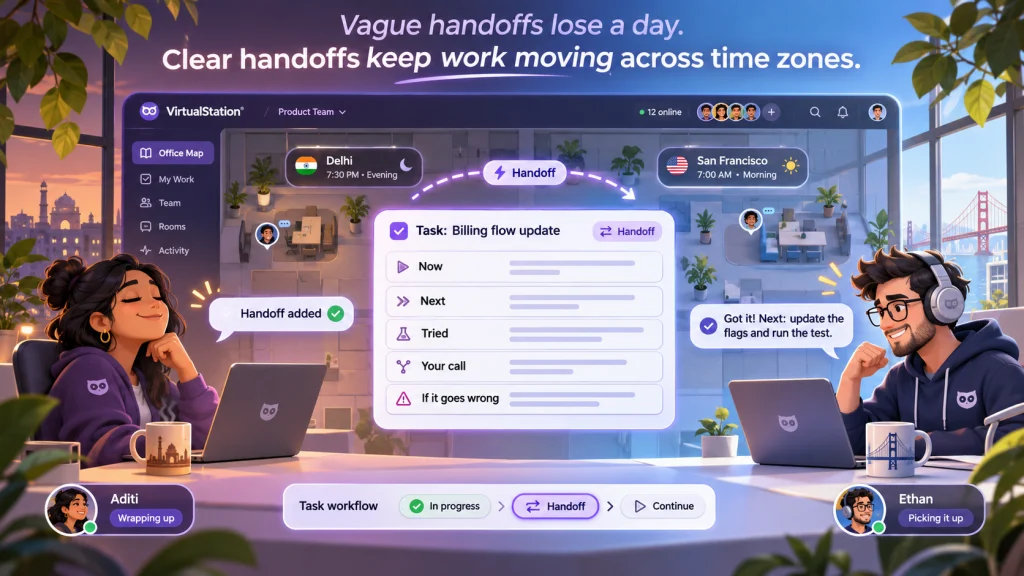
This is our own adaptation for ordinary team work, and it needs nothing but a text field. Write it for one named person.
- Now: what is true at this moment, with a link. No progress words.
- Next: the first step, small enough to start within five minutes without asking anything.
- Tried: what you have already ruled out, so nobody spends a morning repeating it.
- Your call: what they may decide without you, and what has to wait for you.
- If it goes wrong: what to do if Next fails, and when you are back.
Here is the Delhi note again, rewritten as a made-up example:
- To: Sam
- Now: Payment retry is on the staging branch (link). Two of three test cases pass. The expired-card case fails.
- Next: Run the expired-card test with the sandbox card listed in the ticket. Start there.
- Tried: It is not a timeout. I raised the limit and it still fails.
- Your call: If the fix stays inside the retry logic, ship it behind the flag. If it changes customer-facing error messages, leave that for me, because support has to sign off.
- If it goes wrong: Turn the flag off, note it here and pick up the invoice task. I am back at 9:30 a.m. Delhi time, about 9 p.m. yours.
It takes a few minutes to write. “Your call” is the line that does the most work, and it is the one almost nobody writes, because the sender already knows the answer.
The Rule: The Work Stays Yours Until They Reply
A format without a rule becomes a nicer way to drop things. So add one:
A handoff is finished when the named person replies with the first thing they will do. Until then, the work still belongs to the sender.
The reply is one line: “Starting with the expired-card test, will ship behind the flag if the fix stays in retry.” That is the read-back, and it does two jobs. It shows the receiver understood, and it makes silence visible. The first thing the sender does each morning is check for replies. No reply means the work comes back to them, or they chase it. A dropped handoff now costs one day, not a week of everyone assuming.
It will not stop a wrong turn on the day itself, but the wrong turn gets caught at the next start of day. Three more habits make it hold:
- Keep it on the task, not in chat. Chat can carry a link. Three weeks from now someone will need this note, and the task is where they will look.
- Do not hand off what should not travel. A half-made decision or a design argument in progress usually loses more in transit than it gains from the extra hours. Our view: let it wait for its owner, and send only work that can move without them.
- Spend your overlap on the exceptions. If you have an hour together, use it for the Your call items that keep coming back, not for reading status aloud.
Try It on One Work Stream Tomorrow
- Pick the work stream that waits the most across a time zone gap, not the whole company.
- Paste the five lines into your task template, or a saved snippet if your tool has no templates, and agree the reply rule with the people on it.
- For two weeks, log two numbers for each handoff: how many questions it produced, and the hours from handoff to first action.
- Read each question as feedback on a line. “What should I do first?” means Next was thin. “Am I allowed to?” means Your call was missing. Fix the line that keeps failing, and leave the rest alone.
Related reading: how to run an async standup.
The Format Needs a Home, and Ours Is One Option
The format needs a home, and any tool with tasks and comments will do. In VirtualStation, projects and tasks keep owners, due dates, files, comments and checklists together, so a handoff can sit on the work itself. AI standups, available from Pro, collect updates asynchronously and organize progress, plans and blockers, and team presence shows local working hours. None of it will write a good Your call line for you. That part stays human, in our tool or any other.
Write the handoff for someone who cannot ask you anything, because for the next twelve hours they can’t.
Sources
From the VirtualStation team
See who's around, what's moving and what's stuck
VirtualStation puts your team's presence, meetings, chat, tasks and AI standups in one workspace, so the answer to "how's it going?" is already on screen.
No credit card required